The Bank of Canada makes its rate call this Wednesday, and I will post a short note that day on what it means for your mortgage. This is not that note. Before the headline lands and everyone spends five minutes arguing about the merit of no change (hopefully), I want to step back and lay out what is actually happening in the Canadian economy. The real story is bigger than any single BoC meeting, and most of what you will read this week walks right past it.
A year ago, I was writing that the Bank was late, pressing snooze while the economy quietly deteriorated. The picture today is more complicated, and more interesting, than the official narrative admits. So here is the whole thesis.
We are in a recession, but towards the end of it
Let me be direct about something I have been saying for a year. Canada is in a recession, and it has been for longer than the data lets on.
Statistics Canada confirmed that Q1 2026 GDP was essentially flat, with the annualized figure slipping into negative territory, badly missing the consensus that called for growth. That follows a contraction in Q4 2025. Strip out the noise, and you have roughly four quarters with no real growth. The one positive print in that stretch came largely from a one-time spike in military procurement and government capital, not from a private economy that was actually expanding. In plain terms, the "recovery" quarter was a Navy destroyer purchase.
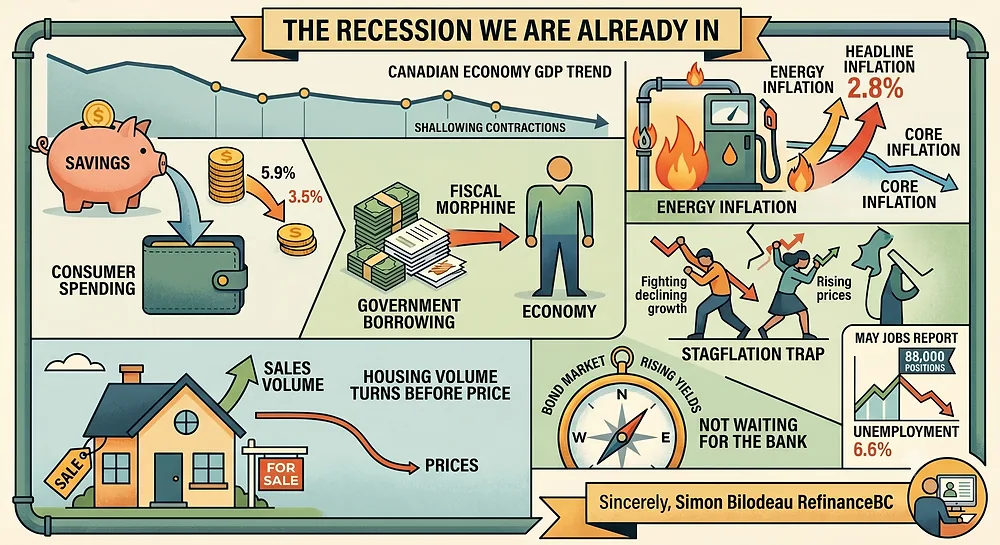
Here is the part almost nobody is connecting. The recession looks mild only because every level of government is spending enormous amounts of borrowed money to soften it. That is fiscal morphine, not a cure. Strip the deficit spending out and the underlying private sector economy looks considerably worse than two quarters of marginal contraction.
And it gets worse on the fiscal side. The deficits are going to come in larger than the projections claim, for a reason that is almost mechanical. In a recession, government revenue falls. Less income tax, less corporate tax, less GST as activity cools. Ottawa builds its deficit forecasts on revenue assumptions that a shrinking economy will not deliver. So you have spending staying high while the income side erodes underneath it. The gap widens whether they admit it on schedule or not. Add to that the fact that a growing share of the spending is simply interest on existing debt and transfer payments, neither of which builds anything productive, and you get the worst of both worlds. Record borrowing, very little growth to show for it.
Now let me give you the other side of that, because it would be dishonest to leave you only with the gloom. The level is poor, but the trajectory is improving. On an annualized basis the economy shrank 1.8% in the second quarter of 2025, then 0.8% in the fourth, then just 0.1% in the first quarter of 2026. Each contraction is shallower than the one before. The single quarter of apparent growth wedged in between deserves an asterisk, because it was not real growth. Part of it came from that one time surge in military spending, and part of it came from imports falling. A drop in imports lifts GDP on paper, since imports are subtracted in the calculation, but for a country that buys most of its finished goods from abroad, fewer imports actually means households and businesses pulling back. Strip the illusion out and the underlying economy was decelerating. That is what the early stage of a bottom tends to look like, and you will see the same shape in the housing numbers further down.
The freshest piece of evidence landed last Friday, and it points the same way. The May jobs report came in strong. The economy added 88,000 positions and the unemployment rate fell to 6.6%, down from 6.9% in April, unwinding most of the climb we saw through the spring. The gains were broad based, spread across age groups and led by the private sector rather than government hiring, and British Columbia accounted for 25,000 of them.
Before anyone gets carried away, a word of caution, and I would say this even though the number went my way. I treat any single jobs report with a heavy dose of skepticism. The monthly Labour Force Survey is exactly that, a survey, with a margin of error that runs to tens of thousands of jobs in either direction. The headline bounces around enough that in any given month it can read like a randomly generated number. Strong one month, weak the next, and a good chunk of it quietly revised away later. So I am not hanging anything on the 88,000 itself, and the year over year picture for full time work is still soft. What makes this print worth mentioning is not its size, it is its direction. It leans the same way as the GDP trajectory and, as you will see, the housing numbers. One noisy data point is just noise. A handful of them pointing the same way starts to sketch the outline of a trend, and that, not the headline figure, is the only reason it earns a place in this blog.
The consumer is holding the line, but the saving rate is falling
So who is keeping the economy off the floor while business investment and trade drag it down? You are. The Canadian household. Consumer spending actually grew through the worst of it, up 0.7% in the fourth quarter and another 0.4% in the first, even as almost everything else shrank. That resilience is the single biggest reason the recession has stayed shallow.
But here is what is funding it, and this is the part that gives me a bad long-term feeling. Households are spending more by saving less. The savings rate has fallen from 5.9% in late 2024 to 3.5% at the start of 2026, the lowest in two years and drifting toward the roughly 2% that was normal before the pandemic. People are not spending more because they are flush. They are spending more dollars to keep up with prices, and covering the difference out of their savings. Statistics Canada said it plainly for the first quarter. Spending rose faster than income, which is exactly why the cushion shrank.
I am aware that a national savings rate is never going to be high. Students and workers under twenty-five are not saving much, retirees are drawing down rather than putting away, and that is normal. The saving is supposed to come from working age earners in their prime, and a 3.5% average tells you that even that group is barely setting anything aside.
Savings are not idle money sitting in a drawer. They are the down payment that lets a family buy a home. They are the capital that funds a small business. They are the bid that absorbs the government bonds Ottawa keeps issuing. They are, in the end, simply the spending of tomorrow. A country that runs its savings rate down to prop up consumption today is quietly borrowing demand from its own future. The economists who measure the economy by how much we spend are cheering the resilient consumer. The part of me that has watched what happens to people with no buffer is not.
And it lands directly on the housing market, which is my world. Real estate runs on savings. No down payment, no move. A household sector that has spent its cushion is a structurally weaker pool of future buyers, no matter where rates go. So even as I see the cyclical turn in the sales data, the longer arc keeps me cautious rather than giddy.
Inflation is back above target, and it is the wrong kind
Inflation rose to 2.8% in April, up from 2.4% in March. That is the highest reading in two years.
The driver is energy. Gasoline was up nearly 29% year over year, and energy as a whole was up around 19%, the fastest pace since 2022. This is the war in the Middle East feeding directly into Canadian prices through the pump and the utility bill.
Now, a quick word on a term you will hear the Bank repeat, because it explains a lot about the bind it is in. Headline inflation is the all items number, the one that includes everything, gas and groceries included. Core inflation is the Bank's preferred measure, and it deliberately throws out the most volatile prices, the ones that swing hard month to month like energy and food. The Bank does this through what it calls its trimmed mean and median measures, which essentially discard the largest price moves in both directions to reveal the underlying trend. The idea is simple. If your gas bill spikes one month, that tells you about oil, not about whether inflation is broadly embedded in the economy.
That distinction matters right now, because core inflation actually cooled slightly even as the headline number jumped. In other words, the spike is concentrated in energy rather than spread across everything you buy. That is the one thread that keeps this from being a broad-based inflation problem. But it is also why the easy path out is blocked. An economy this weak would normally be in line for relief. Inflation climbing on energy argues the opposite. When both are true at once, the usual remedies stop working cleanly, because anything that eases one problem feeds the other. That is the textbook definition of the stagflation trap, and Canada walked straight into it earlier this year. What is changing now is that the stagnation side is starting to ease. The labour market that looked weak through the spring just firmed, with unemployment falling back to 6.6% in May. An economy with firming employment and above target inflation at the same time is not one crying out for cheaper money. If anything, the pressure is tilting the other way.
The wild card: the war
Here is the variable that could change everything, and it is worth being honest about both sides.
There is renewed talk that the conflict in Iran could be winding down. The market has started to lean into that possibility, and the logic is straightforward. If the shooting stops, oil supply normalizes and the energy spike that has been driving our inflation fades. That is the optimistic case, the latest news are not going in that direction.
I would just be careful about how fast anyone expects relief. A ceasefire is not the same as cheap oil returning overnight. Damaged infrastructure takes time to repair. Countries that drained their strategic reserves during the shock have to refill them, and they buy at market prices, which keeps demand and prices elevated long after the headlines move on. The realistic path for oil is not a snap back to where it was. It is a slow settle to a level that is still meaningfully higher than before the war, and still inflationary. There is also nothing stopping Iran from extracting a toll for safe passage through the Strait of Hormuz as a condition of any de-escalation. So yes, a genuine end to the war would take real pressure off prices. I just think the relief would arrive smaller and slower than the market is currently hoping, and a great deal of the economy, inflation and borrowing costs included, hangs on which way it breaks.
Housing: volume turns before price, and volume is turning
This is the part of the picture that is quietly improving, and it matters most if you are thinking about buying.
Start with the headline because it is less alarming than it first looks. Prices in Greater Vancouver are down on a year-over-year basis. The composite benchmark sits around $1.1 million, off 6.2% from a year ago, with detached down 8.3% and condos down 7.9%. Those numbers are real, but they are a rearview mirror. A year-over-year figure measures a decline that, for the most part, already happened over the past twelve months. It tells you where the market has been, not where it is heading.
Look at the fresh data and the read shifts. Month over month, the composite benchmark has essentially stopped falling, holding flat after a long slide. A market that dropped hard for a year and is now levelling off month to month, it is not a market in free fall. It is a market feeling for its floor.
And underneath price, demand is returning exactly where it tends to lead. Detached home sales in May were up compared with a year ago, the first segment to turn. Notice that detached prices are still soft even while its sales rise. That is not a contradiction, it is the signal. At every housing bottom, volume moves first and price follows later, sometimes much later. Buyers come back, sales firm, inventory slowly draws down, and only then do prices steady and lift. Volume is the headlight, price is the taillight, and right now, the headlight is coming back on in the most expensive segment of the market.
This is not a boom call, and I am not telling you to rush. Prices are still soft and there is no urgency in the numbers. But declines that have stopped accelerating, paired with demand quietly returning, are what the early innings of a recovery look like, and it lines up with the improving GDP trajectory and the firmer jobs picture from earlier in this letter. The catch for buyers is timing. The market never feels safe at the bottom. It feels safe well afterward, once prices are already climbing and your leverage is gone. The nervous sellers and the room to negotiate that work in your favour today tend to fade quietly, before the headlines admit the turn happened.
The bond market is where this all comes together
If you want to know where the real risk sits, it is not the Bank of Canada's overnight rate. It is the bond market, and it is the part of this story I am watching most closely.
Here is the distinction that almost nobody outside the industry pays attention to. The rate the Bank sets is one thing. The rates that actually price five-year fixed mortgages, car loans, and the government's own borrowing are set in the bond market, and the bond market does not wait for the Bank. Right now, the two are pulling apart. The Bank has been frozen for months, but government bond yields have been climbing on exactly the forces this letter has described: energy-driven inflation, the war risk premium, and a federal government issuing a record amount of new debt that somebody has to buy.
The recent calm there is fragile. Yields actually eased over the past few weeks, but only because the market chose to believe two things at once, that the war winds down and oil falls, and that inflation stays contained. Those are the two assumptions I trust least. If either one breaks, and the months ahead are full of ways for them to break, yields move higher in a hurry.
Underneath the headlines, there is a slower pressure that worries me more. The more the government borrows into a weak economy, the more bonds it has to sell, and at some point buyers demand a higher yield to take them. That force does not depend on any single news event. It is the plain math of a country spending far more than it collects, and it pushes the cost of money up no matter what the Bank decides.
I will not tie all of this to your mortgage today. That is Wednesday's note. But if you carry one idea out of this letter, make it this. A frozen central bank does not mean frozen borrowing costs. The number that matters most for what you will actually pay is being set in a market most people never watch, and lately that market has been drifting the wrong way.
Where this leaves us
Here is the whole picture in one breath. We are in a recession that has run longer than the label admits, held up by government borrowing and by a consumer who is funding today's spending by running down savings. The contraction is shrinking, and a few early signals, jobs and housing among them, are pointing up, so the economy may be feeling for a floor. But inflation is back above target and it is the wrong kind, the war keeps a thumb on energy prices, and the bond market is drifting in a direction that matters more for your wallet than anything the Bank announces this week.
That is the why. On Wednesday, once the Bank has spoken, I will send a short note on the what to do, specifically what all of this means for your mortgage and how I would play it.
Sincerely,
Simon Bilodeau and Gina Lopez
604-828-9864
Simon Bilodeau is a mortgage broker, financial writer, and co-founder of RefinanceBC. He specializes in translating economic trends into clear mortgage strategies for BC homeowners. Often featured on Radio-Canada and CBC, Simon is known for honest, data-driven advice delivered in plain language. He works alongside his wife Gina, forming a bilingual team serving clients across the province.