Dear reader,
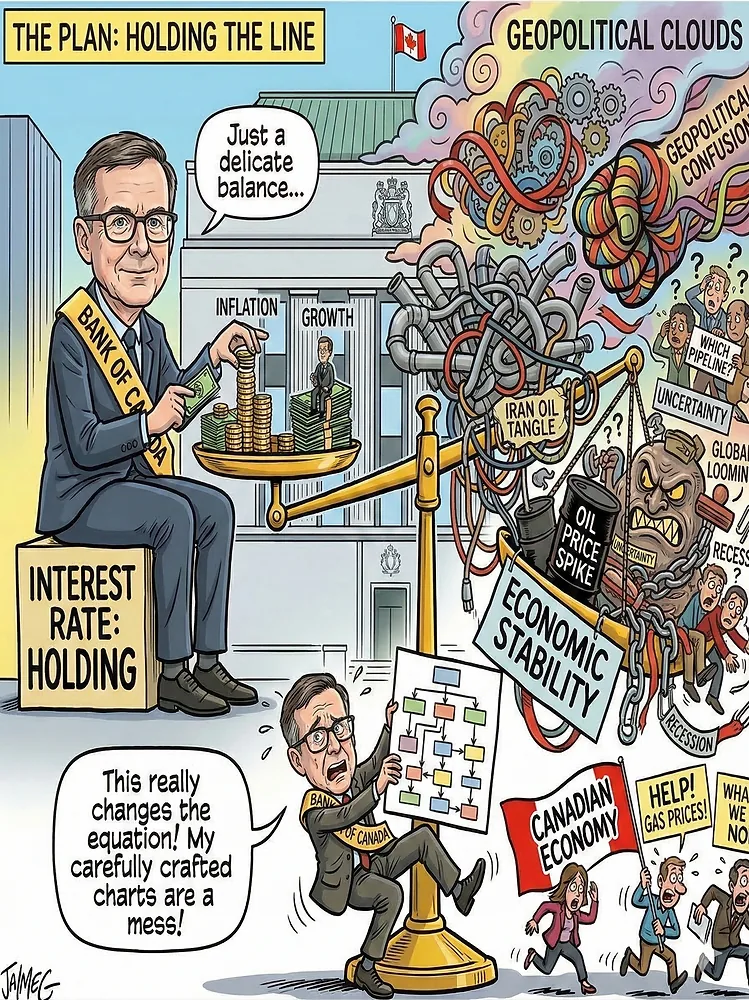
This morning, March 18, 2026, the Bank of Canada announced its decision to maintain the overnight rate at 2.25%, leaving the mortgage prime rate unchanged at 4.45%. No surprise. The Bank had every reason to stay put — and the data we received just days before this decision made it even clearer.
The Economy: Not Great, Not Dead
Let's look at the actual numbers, because they paint a pretty honest picture of where Canada stands right now.
GDP: The Canadian economy contracted by 0.6% (annualized) in Q4 2025 — worse than the Bank of Canada's own projection of a flat reading. For all of 2025, the economy grew 1.7%, a step down from 2024. Statistics Canada's advance guidance for January points to flat growth, meaning we entered 2026 with very little momentum.
Jobs: The February jobs report was, in the words of BMO's chief economist, "weak from head to toe." Canada lost 84,000 positions last month — one of the worst non-pandemic results on record. More than 100,000 full-time jobs disappeared in a single month. The unemployment rate rose to 6.7%, up from 6.5% in January. Economists had been expecting a gain of 10,000 jobs. This was not that.
Consumer spending: With jobs disappearing and uncertainty on the rise, Canadians are pulling back. Durable goods spending has declined for two consecutive quarters. Retail trade has shed 52,000 positions since October. People are being cautious, and that caution is showing up everywhere.
So yes — the economy is alive. But it's not thriving, and the Bank of Canada knows it.
Inflation, however, has been moving in the right direction. The trend is down, which gives the Bank some cover to hold and observe rather than act.
The War in Iran Changed the Math
Here's where things get more complicated.
The conflict in Iran has pushed oil prices sharply higher. For most countries, that's a textbook inflation trigger — energy costs go up, and everything else follows. The financial markets have already priced this in, which is why fixed mortgage rates have moved higher even though the Bank of Canada didn't touch its rate today. Bond markets don't wait for permission.
Could the war be short-lived? Yes, it's possible. If the conflict de-escalates quickly, things could drift back toward the trajectory we had before — one that included a real possibility of further rate cuts in the coming months. But the chances of that happening are low, and with every passing day the conflict continues, the risk of inflation running hotter gets worse. The longer this goes, the more entrenched the inflationary pressure becomes in supply chains, energy markets, and consumer prices.
Now, here's the Canadian wrinkle worth knowing: we're an oil-producing country. Higher oil prices mean stronger revenues for our energy sector and upward pressure on the Canadian dollar, which helps offset some of the inflationary impact from imports. So the effect on Canada isn't as dramatic as it would be for an oil-importing economy. But "not as dramatic" doesn't mean painless. The market is already planning for inflation, and that's showing up in fixed rates.
What This Means for Your Mortgage
If you're on a fixed rate: Nothing changes for you today. Sit tight. If you have a renewal coming up, looking at it sooner rather than later may be a good idea.
If you're on a variable rate: This is the moment to have a serious conversation.
There was a window — a real one. Over the past few months, the projections pointed toward possible further rate cuts in the coming months. If you were on a variable rate and thinking about switching to fixed, that window represented a genuine opportunity to lock in while rates were drifting lower. The war in Iran narrowed that window considerably. The rate cut that might have come is now much less likely, and fixed rates have already moved higher in anticipation of inflationary pressure.
One thing worth knowing: switching from a variable rate to a fixed rate with your current lender is typically penalty-free. You don't have to break your mortgage to make this move.
But does that mean everyone on a variable rate should lock in right now? Not necessarily. It depends on your specific rate, your term, your financial situation, and your personal tolerance for uncertainty. Some people will be better off staying variable. Others will sleep better with the certainty of a fixed rate and payment.
Before you do anything, call me. We'll look at your numbers together and figure out what actually makes sense for your situation. What's right for your neighbour might be wrong for you.
If You're Looking to Buy
This is still one of the better buyer's markets in years.
Inventory is high. Sales have been slow, which means sellers are motivated and bidding wars are rare. You have time, options, and leverage at the negotiating table. The national benchmark home price is down about 4.8% year over year, and in most markets you're not racing anyone to the finish line.
But here's the thing: with fixed rates already moving up and global uncertainty rising, the protection that comes with a pre-approval matters more than it did six months ago. A pre-approval locks in a rate for 90 to 120 days. If rates go up, you're protected. If they come down, you get the lower rate. It costs nothing and gives you a ceiling.
If a purchase is on your radar this spring, get pre-approved now. Don't wait until you've found the property you love to start the paperwork.
The Bottom Line
The Bank of Canada held today, as expected. Inflation is trending down. The economy is muddling through — with real signs of strain in both GDP and the job market. And the situation in Iran has added a layer of uncertainty that financial markets have already acted on.
If you're on a variable rate and considering a switch to fixed, today is a good time to have that conversation. The move can be done penalty-free with your existing lender, and the risk picture has shifted. Don't wait for perfect conditions — they may not come.
Simon Bilodeau and Gina Lopez
604-828-9864
Simon Bilodeau is a mortgage broker, financial writer, and co-founder of RefinanceBC. He specializes in translating economic trends into clear mortgage strategies for BC homeowners. Often featured on Radio-Canada and CBC, Simon is known for honest, data-driven advice delivered in plain language. He works alongside his wife Gina, forming a bilingual team serving clients across the province.