
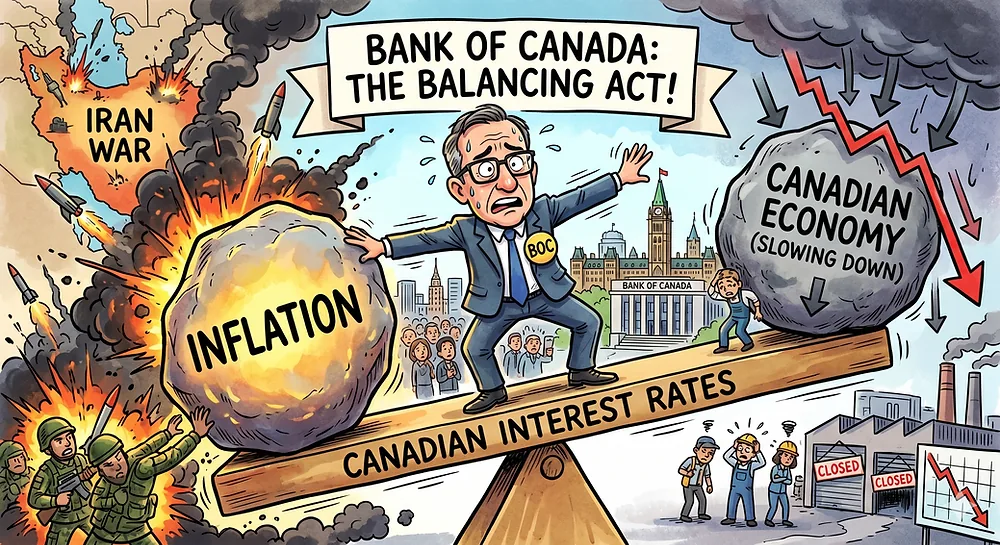
Wednesday, April 29. The Bank of Canada holds its overnight rate at 2.25%.This means that the mortgage prime rate is holding at 4.45% for most banks. No surprise. If you were expecting a cut, you haven't been following the news closely enough.
Let me explain what is actually going on.
The Squeeze in Both Directions
The Bank is caught between two forces pulling in opposite directions, and the Iran conflict is the reason neither side wins right now.
On one hand, Canada's economy is soft. Unemployment climbed to 6.7% earlier this year after employment gains from Q4 2025 were almost entirely reversed in the first two months of 2026. Growth is weak. Tariff uncertainty from the US is still compressing business confidence. Under normal circumstances, that is the setup for rate cuts.
On the other hand, inflation is climbing back up — not because of domestic demand, but because a war on the other side of the planet closed the most important oil shipping lane in the world.
When the US and Israel struck Iran in late February, Iran responded by closing the Strait of Hormuz. That strait handles roughly 20 percent of global crude oil supply. Crude oil, which was sitting around USD $70 per barrel before the conflict, surged past USD $112 and is currently trading around USD $108, with plenty of volatility in between as ceasefire talks start and collapse on a near-weekly basis. Canada's CPI came in at 1.8% in February. By March, it was already back at 2.4%, driven almost entirely by fuel. BMO's chief economist has warned headline inflation could breach 3% in April as the full price shock works through the system.
You cannot cut rates into accelerating inflation. You cannot hike into a weakening labour market. So you hold. And you watch.
Why This Is Not a Temporary Blip
This is the part I want you to understand clearly.
The ceasefire talks between the US and Iran are going nowhere fast. The Strait of Hormuz remains functionally impaired. Insurance costs for shipping have exploded. Even if a deal gets done tomorrow, it takes months for global commodity flows to normalize, and the damage to Gulf infrastructure means supply will not snap back cleanly and especially not quickly.
Iran's strategy is deliberate: make the economic cost of this war so high that pressure for de-escalation builds from within the coalition. That strategy is working. Every week this drags on, the inflation picture in Canada, Europe and the US gets more complicated. Every week, fixed mortgage rates face more upward pressure from bond markets pricing in that risk.
The Bank has said it will look through the initial spike. But there is a limit to how long it can do that if energy prices stay elevated and start feeding into broader price categories. We are not there yet. But the door to rate cuts in Canada is essentially closed for now, and the question on the table for the second half of 2026 is not whether rates come down, it is whether they have to go up.
What This Means for Your Mortgage
Here is where I will be direct with you.
Fixed rate holders: Nothing changes for you today. Your rate is locked. Stay the course.
Coming up for renewal in the next six months: Do not wait until the last minute on this one. The rate environment is not going to be dramatically better six months from now, and it could be worse. Let's look at your options now, build a strategy, and position you properly before your term expires. Reach out, and we will sit down and go through it.
Variable rate holders: You are actually in a decent spot right now. Your rate moves with prime, and prime has been sitting still since October 2025. You are carrying a strong rate. My advice is to hold your position. Now, one thing worth knowing: if you do decide you want the certainty of a fixed rate, converting from variable to fixed with your current lender typically carries no penalty. It is a straightforward product switch. That said, my read right now is to wait and see what happens with Iran before making that call. If the situation escalates materially and bond yields start moving hard, we revisit together.
Thinking about buying: This is actually a good moment to move on a pre-approval. Prices have softened, particularly in the condo market, which has seen some of the most significant corrections. You have more negotiating room as a buyer right now than you have had in years. Locking in a rate hold through a pre-approval gives you protection if rates do move upward, and costs you nothing. The window where prices are down and rates have not moved yet is not going to stay open indefinitely.
The Bottom Line
The Bank of Canada did exactly what was expected today. The more interesting question is what comes next, and the answer to that question is being written in the Persian Gulf, not in Ottawa.
Stay informed. Make decisions with a strategy behind them, not a guess.
As always, if you have questions about your specific situation, I am here.
Simon Bilodeau and Gina Lopez
604-828-9864
Simon Bilodeau is a mortgage broker, financial writer, and co-founder of RefinanceBC. He specializes in translating economic trends into clear mortgage strategies for BC homeowners. Often featured on Radio-Canada and CBC, Simon is known for honest, data-driven advice delivered in plain language. He works alongside his wife Gina, forming a bilingual team serving clients across the province.