
Dear Reader,
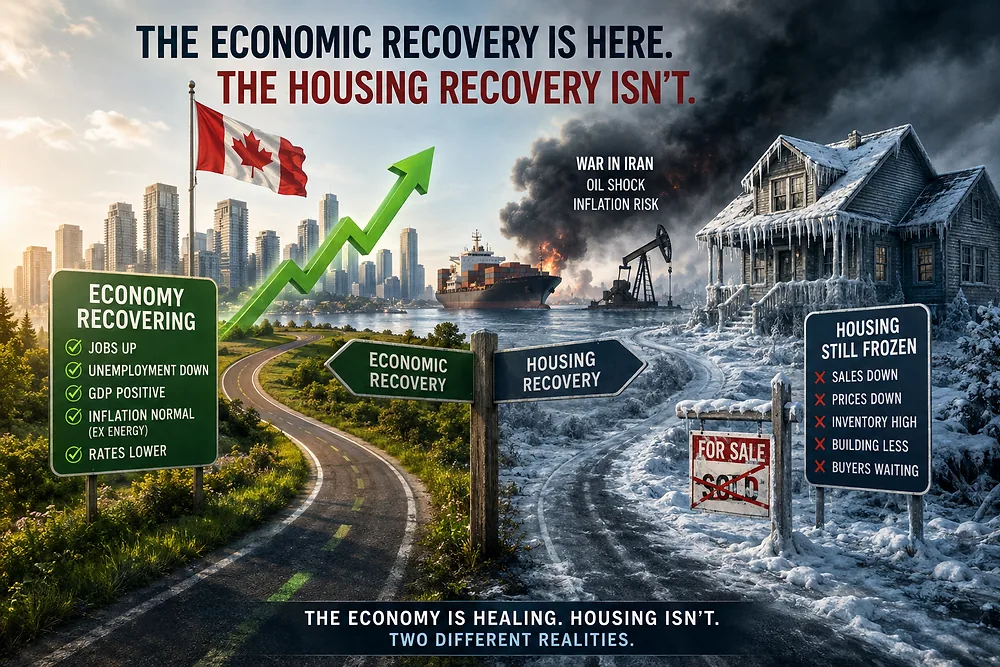
Something strange is happening in Canada. The economy is beginning to look better. Canada is creating jobs. Inflation, once you look beneath the energy shock, is basically back to normal. GDP is positive. Interest rates are well below their peak. Normally, that combination would eventually produce a housing recovery. But it isn't happening. Housing activity remains extraordinarily weak, and July made that disconnect even harder to ignore.
The Economy Is Improving
Let's start with employment. Canada added approximately 75,000 jobs in July, while the unemployment rate fell to 6.4%. That was significantly stronger than expected. Wage growth also slowed to around 2.8% year-over-year, which is important because it suggests the stronger labour market isn't currently creating another major inflation problem.
GDP has also returned to positive growth.
So we are no longer looking at an economy where every indicator is flashing red.
There are certainly still problems, and growth remains weak on a per-person basis, but the economy itself is showing signs of stabilization and recovery.
Inflation tells a similar story.
Inflation Is Back at 3% — But This Isn't a Normal Inflation Problem
Canada's July inflation rate increased from 2.8% to 3.0%. At first glance, that sounds concerning.But the details tell a very different story. Gasoline prices were 25.7% higher than a year earlier.
Meanwhile, the Bank of Canada's two preferred measures of underlying inflation remain almost exactly where the Bank wants them:
CPI-trim: 1.9%
CPI-median: 2.0%
Grocery inflation slowed, and shelter inflation was only around 1.3%. So, despite the 3% headline number, Canada does not appear to have a broad inflation problem right now.
We have an energy-price problem. And that brings us to the war in Iran.
The War in Iran Is Now Showing Up in Canadian Inflation
The war in Iran continues to disrupt one of the most important energy transportation routes in the world: the Strait of Hormuz. Before the war, roughly one-fifth of global crude oil and LNG shipments passed through the strait. Traffic through Hormuz remains severely disrupted. Shipowners and insurance companies continue to avoid the area, attacks on commercial vessels have continued, and negotiations over reopening and controlling the strait remain unresolved. Oil prices have responded.
Brent crude is now trading around US$90 per barrel, after having moved much higher earlier in the war.
And we can already see the effect in Canada. Gasoline prices are up more than 25% from last year and have pushed headline CPI back to 3%. If oil prices come back down, much of this inflation should disappear. If the war continues for the long term, which increasingly appears possible, or if the situation escalates further, energy could remain an inflation problem for Canada even while domestic inflation remains under control.
That puts the Bank of Canada in an unusual position.
My Prediction for September: No Change
The next Bank of Canada decision is September 2.
My current prediction is: No change.
The overnight rate stays at 2.25%.
There isn't much reason for the Bank to raise rates.
Underlying inflation is basically 2%.
But there also isn't much urgency to cut.
Canada just produced a surprisingly strong employment report, headline inflation is sitting at 3%, and the war in Iran continues to create significant uncertainty around oil prices.
The easiest decision for the Bank is simply to wait.
But this is where things become interesting.
If the economy is stabilizing, employment is growing, underlying inflation is normal and interest rates are lower... Where is the housing recovery?
Housing Is Still Dead
For several months, the real estate market appeared to be slowly improving.
Then June finally looked like the turning point.
Metro Vancouver home sales were 9.6% higher than June 2025, with increased activity across all property types. It looked like the recovery might finally be starting.
Then July arrived. Metro Vancouver recorded only 2,061 sales, down 9.8% from July 2025 and an enormous 18.6% below the 10-year seasonal average. The benchmark price fell another 0.9% during the month and is now down 6.2% from a year ago. Apartments were particularly weak, with sales down 17.8% year-over-year. At first glance, that looked like an extraordinary reversal. But Vancouver wasn't alone. Sales were also down roughly 9% in the Fraser Valley and Calgary and around 10% in Montreal. Toronto was the notable exception, with sales roughly flat from last year. Nationally, the picture was somewhat less dramatic. Seasonally adjusted sales actually increased slightly from June, but July sales were still 5.3% below last year. So this isn't simply a Vancouver story.
Last Year's Weird Spring Makes July Harder to Read
Part of the explanation may be the strange timing of the 2025 housing market. Last year's traditional spring market was interrupted almost immediately by the uncertainty created by new U.S. tariffs. Buyers who normally would have purchased in March, April or May delayed decisions. Some of that activity appears to have been pushed into June and July.
That makes the year-over-year comparison unusually messy. In Metro Vancouver, for example, June and July combined produced almost exactly the same number of transactions this year as they did last year. So I don't think buyers suddenly flooded into the market in June and disappeared in July. The more important point is this:
There still isn't much of a housing recovery at all.
And that is surprising. Mortgage rates are lower. Prices are lower. Inventory is available. Employment is improving. Inflation is largely under control.
Yet buyers remain extremely cautious.
The Condo Market Has an Additional Problem
The condo market deserves its own explanation because its weakness didn't suddenly appear in July. Investor demand has been disappearing for several years.
The math simply stopped working. For years, an investor could purchase a condo with 20% down and accept negative monthly cash flow because appreciation compensated for the loss. You could lose a few hundred dollars every month while the property gained tens of thousands of dollars in value each year.
Today, rents often don't come close to covering the mortgage, strata fees, property taxes, insurance and maintenance on a condo purchased with 80% financing. And appreciation isn't covering the loss anymore. Someone putting 40%, 50% or more down may still be able to make the property cash-flow. But then the question becomes whether tying up hundreds of thousands of dollars in a condo with little expected appreciation is the best use of that money. For the typical investor relying on 80% financing, the numbers simply aren't attractive. This has been happening for several years, so it doesn't explain the sudden July decline. But it does explain why apartments continue to perform considerably worse than other property types. And it is beginning to create another problem.
We Are Building Less Housing
CMHC's July housing-start data were not encouraging. Actual housing starts in Canadian urban centres were 19% lower than July last year. Vancouver was particularly dramatic:
Housing starts fell 42% year-over-year. This shouldn't be surprising. Developers build when projects make economic sense. If buyers disappear, presales disappear. If presales disappear, financing becomes difficult. Projects get delayed or cancelled. The irony is that a weak housing market today can eventually contribute to another housing shortage several years from now. We have a large amount of housing currently under construction, so completions should remain relatively strong for a while. The concern is what gets built after that pipeline is finished.
So Why Isn't Housing Recovering?
This may be the most interesting question in the Canadian economy right now.
The conditions that were supposed to revive housing are increasingly present.
Rates are lower. Prices have fallen. Employment is improving. Underlying inflation is around target. And yet buyers remain hesitant. You can see it in the numbers behind the numbers. Active listings in Metro Vancouver are sitting 26.8% above the 10-year seasonal average, even as new listings came in almost exactly on that average. Sellers aren't flooding the market. Buyers just aren't clearing the available inventory.
The sales-to-active-listings ratio is 13%, and for detached homes specifically it's 10.5%, below the 12% threshold where sustained conditions have historically been associated with downward pressure on prices. That's not a market short of options. It's a market short of urgency. I think confidence is becoming just as important as affordability.
For years, buyers in Vancouver were conditioned to believe:
"If I don't buy now, it will cost more next year."
Today, many buyers appear to be thinking:
"Why rush? It may be cheaper in six months."
That change in psychology matters.
A 0.25% drop in mortgage rates doesn't necessarily convince someone to buy if they believe waiting might save them tens of thousands of dollars on the purchase price.
And after several years of economic uncertainty, many households simply don't feel comfortable making the largest purchase of their lives.
That may be why we are seeing something very unusual:
An economic recovery without a housing recovery.
The "wait and see" instinct isn't irrational.
But it isn't free either. Every month of waiting is also a month of not knowing what rates or prices will do next, in either direction. It's also a month that you are paying someone's else mortgage. For buyers who believe mortgage rates will be meaningfully lower six months from now, that is a gamble I personally would not make. The same applies if you're waiting because you expect home prices to be significantly lower six months from now.
Prices could certainly decline further, but I think the most likely outcome is that they remain relatively close to where they are today, perhaps 1% or 2% higher or lower. Much of the price adjustment has already happened, and the pace of decline has slowed considerably.
Waiting may ultimately save you some money, but it could just as easily mean finding yourself six months from now looking at very similar home prices and mortgage rates. At that point, you haven't necessarily gained anything you've simply spent another six months waiting.
What Does This Mean for Buyers?
For buyers who are financially ready, the current market offers something we haven't seen very often in Vancouver.
Lower mortgage rates.
Lower prices.
More inventory.
More negotiating power.
Less competition.
That doesn't mean prices cannot fall further. They can. And I would never recommend buying simply because someone thinks they've perfectly identified the bottom of the market. But if you're buying a home you expect to live in for the next 7, 10 or 20 years, the exact month that represents the market bottom is usually less important than whether the home fits your needs and whether the mortgage fits comfortably within your budget.
For existing homeowners, remember that the Bank of Canada only directly controls variable-rate borrowing.
Fixed mortgage rates are driven much more by bond markets, and the war in Iran, oil prices, inflation expectations and global interest rates can move fixed mortgage rates even if the Bank of Canada does absolutely nothing.
The next Bank of Canada decision is September 2.
My prediction today is no change.
I'll send a shorter update after the decision.
As always, if you're buying, renewing, refinancing or simply trying to understand what these changes mean for your mortgage, feel free to reach out.
Simon Bilodeau and Gina Lopez
604-828-9864
Simon Bilodeau is a mortgage broker, financial writer, and co-founder of RefinanceBC. He specializes in translating economic trends into clear mortgage strategies for BC homeowners. Often featured on Radio-Canada and CBC, Simon is known for honest, data-driven advice delivered in plain language. He works alongside his wife Gina, forming a bilingual team serving clients across the province.