The Bank of Canada will hold tomorrow. The decision that matters is September, and almost every number the Bank will point to is telling you something other than what it appears to say.
The Bank of Canada announces its rate decision tomorrow morning, Wednesday July 15. I will save you the suspense. They are not moving. The overnight rate stays at 2.25%, the mortgage prime rate stays at 4.45%, and this becomes the sixth consecutive hold. The market agrees, pricing a hold at better than nine in ten.
So if you have a variable rate, your payment does not change this week. If you have a fixed rate, you were never tied to this decision anyway. As news, it is a non-event, and most of the coverage you read tomorrow will treat it as one.
Here is what I think is actually going on. The Bank is about to hold on the calmest day it is going to get for a while. The real decision is September 2. And between now and then, the numbers that look reassuring are going to keep looking reassuring right up until the thing that actually matters lands on top of them.
Let me take the numbers the Bank is leaning on and turn each one over.
Number one: the inflation is one commodity
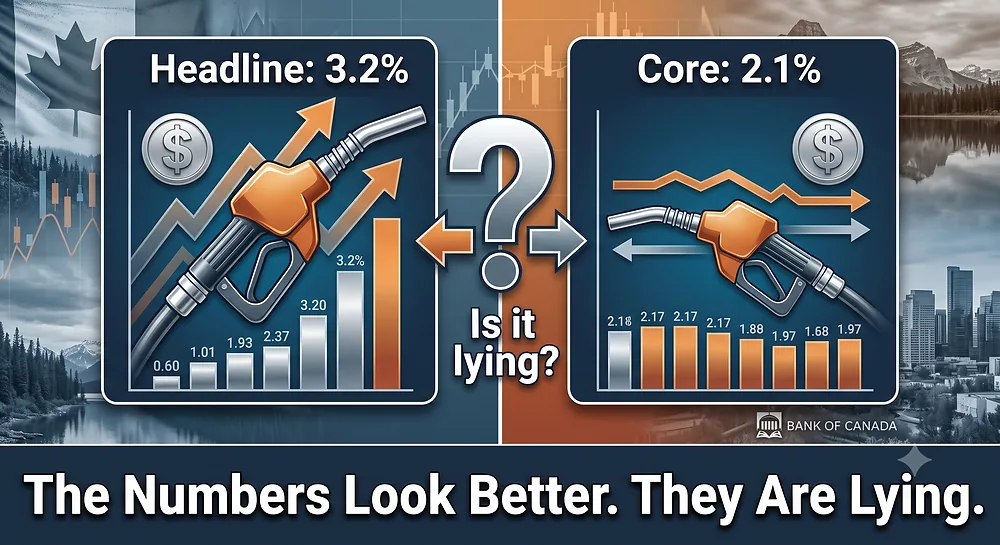
Headline inflation hit 3.2% in May, up from 2.8% in April. The fastest pace in more than two years. That is the number that makes central bankers reach for the lever.
Now go one layer down into the same report. Strip out gasoline and inflation was 2.2%. The Bank's own preferred core measures, trim and median, averaged 2.1%, unchanged from April. Services inflation was 2.0%, still well below its pace over the last four years. Core goods inflation actually cooled.
The entire distance between a comfortable 2.2% and an alarming 3.2% is the price at the pump. Gasoline was up 33% year over year.
This is not an economy where prices are climbing because Canadians are spending freely and businesses have pricing power. It is an economy where one commodity, priced in a shipping lane eleven thousand kilometres from here, is dragging the headline around behind it. Interest rates are built to fight domestic demand-driven inflation over commodity prices rising.
Number two: the ceasefire is already gone
In June, an interim US-Iran agreement began reopening the Strait of Hormuz. Tankers moved, oil fell back to roughly pre-war levels, and it briefly looked like the energy shock was going to solve itself. Had that held, this entire inflation episode would have deflated quietly and the Bank would never have had to decide anything.
It did not hold. It is unravelling as I write this.
The United States has struck Iran for three consecutive days. Iran's Revolutionary Guard declared the Strait of Hormuz closed on July 12, has attacked two oil supertankers transiting the waterway, and has fired missiles and drones at the UAE, Qatar, Kuwait, Oman and Bahrain. Traffic through the strait is grinding to a halt, back to or below where it sat before the agreement. Brent crude is trading near $87 and West Texas Intermediate has pushed past $80, the highest in a month and roughly 19% above where oil sat before this war began.
An interim agreement between two parties still shooting at each other was never a durable foundation. A truce with a clock on it comes apart on schedule, and this one has.
Two details from the last forty-eight hours deserve far more attention than they are getting.
The shock absorber is gone. The reason oil survived four months of a closed strait without going vertical is that the United States was draining its strategic petroleum reserve to cover the gap. Commodity analysts now say that cushion has been largely used up, leaving the market much more exposed to a rerun of March and April, and that a violent upward repricing cannot be ruled out. The buffer that made the last four months tolerable has been spent. There is nothing underneath the next shock.
And Washington is now taxing the strait directly. The President announced this week that the United States will act as guardian of the waterway and levy transit fees on ships passing through it, at a rate of 20% on all cargo shipped, while reimposing the blockade of Iranian ports.
Read that again. A 20% toll on roughly a fifth of the world's seaborne oil, and on about a third of its seaborne fertilizer. That is not a market outcome. It is a deliberate, policy-created price increase, imposed at a choke point, that gets passed straight down the chain to every person who buys fuel or food anywhere on earth. Including you.
Number three: the grocery bill nobody is pricing yet
Here is the piece almost nobody outside the commodity desks is discussing, and it is why I do not think the serious inflation problem arrives this year.
Hormuz does not only carry oil. It carries roughly a third of the world's seaborne fertilizer trade, with nitrogen and phosphate the most exposed. Close the strait, or tax it at 20%, and you have not only raised the cost of filling your tank. You have raised the cost of growing food, everywhere, for the next planting season.
The first traces are already visible. Food inflation ticked up to 3.8% in May, led by fresh fruit and vegetables, tied to higher fertilizer costs.
But fertilizer moves slowly. It works through the cost of a crop, and the crop works through the price of what sits on your shelf, and that chain takes seasons rather than months. Which is why my read is this: outside of energy, broad inflation is not really going to show up this year. If the strait stays contested, the real problem is a 2027 problem.
And a central bank that hikes in September, into a recession, because of what it fears about 2027, is a central bank fighting an inflation that has not arrived, with a tool that cannot reach its cause.
Number four: the unemployment rate is an optical illusion
This is the number that will do the most damage to clear thinking, because it looks so encouraging.
Canada added 18,000 jobs in June. Unemployment fell to 6.5%, the second decent report in a row. Wage growth for permanent employees picked up to 3.7%. Headlines called it a labour market finding its footing.
Look underneath.
The labour force barely grew. That is the entire story. When Canada was adding population rapidly, we needed forty or fifty thousand new jobs a month just to hold the unemployment rate steady. With immigration slowed and the labour force now essentially flat, a mediocre 18,000 is suddenly enough to push the rate down. The rate is not falling because the economy is creating work. It is falling because the denominator stopped growing. Same weak job creation, better looking headline.
Then look at what those jobs actually were. The gains were led by wholesale and retail trade and by food and accommodation. They were primarily part-time. And 33,000 of them went to workers aged fifteen to twenty-four in a better summer student market. Meanwhile, manufacturing led the losses and is down roughly 61,000 positions since its early-2025 peak, ground down by tariffs. Canada is still net negative about 95,000 jobs on the year.
A stalled labour force, part-time summer work in shops and restaurants, and a manufacturing sector quietly bleeding. That is not a tightening labour market. That is a labour market being flattered by demographics.
Number five: the consumer is not confident, the consumer is out of savings
The last thing holding this economy together is the Canadian household, and it genuinely has. Consumer spending rose in the first quarter, after rising the quarter before. The household sector is close to the only reason a technical recession has not already become something worse.
So people are spending. The question is what they are spending.
In the first quarter, disposable income rose 0.6% while consumption rose 0.9%. Spending is outrunning income. And the household savings rate fell to 3.5%, the lowest since early 2024, down from 5.9% not long ago.
That is not the signature of a confident household. It is the signature of a household covering the gap out of the buffer.
The Bank's own consumer expectations index has now sat in negative territory for eighteen consecutive quarters. The modest improvement it recorded this spring came from a survey conducted in February, before the war started. When the Bank went back and asked households after the fighting began, most said they expected the conflict to weaken the economy and raise prices.
So the resilient consumer is a consumer with a thinning cushion, a pessimistic outlook, and a fuel bill that is climbing again as we speak. That is not strength. That is a countdown.
And yet the herd is running
Which brings me to what actually worries me about September.
In June the European Central Bank raised rates for the first time since 2023. They did it explicitly because of the war and the energy shock, and they explicitly rejected the idea of looking through it. They hiked into a eurozone economy that had contracted in the first quarter, and markets expect them to hike again in September.
Consider what Europe just did. They import nearly all their energy. The war made everything more expensive for them, so their response was to make borrowing more expensive on top of it, while their economy was shrinking. Stagflation arrived, and the policy answer was to tighten into the weakness.
Canada is not Europe, and the difference is not cosmetic. We produce oil. When crude spikes, our national income rises even as drivers feel it at the pump, and our currency tends to firm alongside it. We have a cushion a pure energy importer does not have, and the Bank has made this point itself.
So if the ECB hiking into a contraction is questionable, Canada copying it would be importing a policy designed for a country in a completely different situation. But central bankers do not enjoy being the outlier. When peers move, the gravity is real, and nobody wants to be the one who was too slow.
A rate hike does not end a war
Let me be blunt about the thing nobody says from a podium.
Raising the overnight rate does nothing about a war on the other side of the planet. It does not reopen a strait. It does not clear a minefield or refloat a struck tanker. It does not lower the price of crude by a single cent, and it certainly does not repeal a 20% American toll on cargo crossing the Strait of Hormuz.
What it does do is make every mortgage, every line of credit, and every business loan in this country more expensive. In an economy that is in a technical recession. That is down 95,000 jobs on the year. That is bleeding manufacturing under tariffs. Whose consumers are already dipping into savings to get through the month.
So if the Bank hikes in September, be clear about what it would actually be. It would be a gesture. It would be a central bank wanting to stand at a podium and say it is doing something about inflation, when the inflation in question is a price being set in a shipping lane by people who have never heard of the Bank of Canada. Doing something and doing the right thing are not the same, and here they point in opposite directions.
The honest cost of holding
There is one genuine price for holding while your peers tighten, and I will not pretend otherwise. A lower rate than your peers means a softer Loonie.
That is a tradeoff, not a catastrophe. A softer dollar makes our exports cheaper and more competitive at exactly the moment tariffs are trying to price them out of the American market. It cushions the trade fight and protects jobs at the margin. The cost lands on the other side of the ledger, in more expensive imported finished goods. You gain on what you sell to the world and you lose on what you buy from it.
My read is that this is the better of two imperfect trades. Choking a recessionary economy with higher borrowing costs, to defend an exchange rate, to fight an inflation number that is one commodity in a shipping lane, is a worse deal than accepting a weaker dollar and holding the line a little longer than is comfortable.
What to watch, and what it means for your mortgage
Tomorrow is not the event. Watch three things between now and September 2.
Where oil settles, and whether the strait stays contested. Whether core inflation, the 2.1% that actually matters, starts drifting up instead of holding flat. And whether the labour force starts growing again, which is the only thing that would make a falling unemployment rate mean what people think it means.
And watch the bond market, because that is the piece that touches your mortgage directly. The Bank can freeze the overnight rate. It cannot freeze bond yields. Fixed mortgage rates are priced off Government of Canada bonds, and the five-year yield has pushed toward 3.1% while the ten-year recently hit its highest level since May. A central bank standing perfectly still does not mean fixed rates standing still. Those are two different levers, and the space between them is exactly where your renewal gets decided.
I will send my note on what this means for your specific situation, fixed versus variable, renewals, and purchases, after tomorrow's announcement.
For now, the summary is this. The good numbers are not good. The unemployment rate is falling because the labour force stopped growing. The consumer is spending because the savings are draining. The inflation is one commodity, and its cause did not fade. It came roaring back, with the shock absorber spent and a toll booth going up at the chokepoint.
The biggest risk to Canadian borrowers between now and the fall is not in the data. It is a central bank feeling the pull of a global herd and reaching for a tool that cannot fix the problem it would claim to be solving.
In September, the courage will not be in acting. It will be in refusing to.
Sincerely,
Simon Bilodeau and Gina Lopez
604-828-9864
Simon Bilodeau is a mortgage broker, financial writer, and co-founder of RefinanceBC. He specializes in translating economic trends into clear mortgage strategies for BC homeowners. Often featured on Radio-Canada and CBC, Simon is known for honest, data-driven advice delivered in plain language. He works alongside his wife Gina, forming a bilingual team serving clients across the province.