
Dear reader,
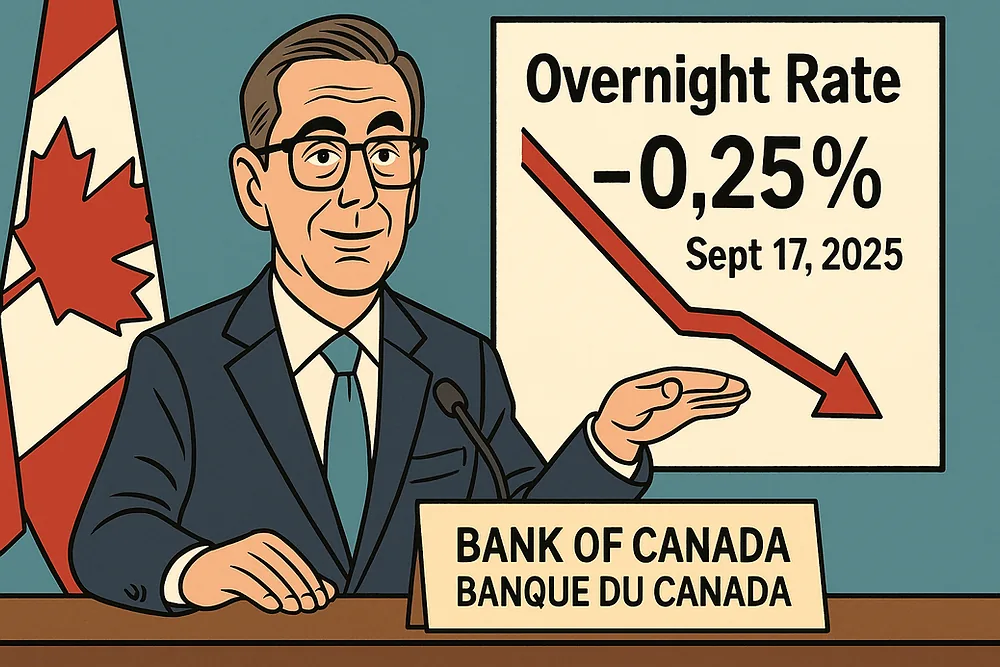
This morning (September 17, 2025), the Bank of Canada (BoC) lowered its overnight rate by 0.25% to 2.50%. The prime rate, which most variable-rate mortgages and lines of credit are priced off, now sits at 4.70%, providing immediate relief to variable-rate borrowers.
Why is the BoC cutting now?
The Canadian economy has clearly slowed. Some of this was widely expected after Q1 was boosted by businesses front-loading purchases ahead of tariffs. But the slowdown ran deeper than hoped: Q2 real GDP fell to –1.6% annualized. In short, tariffs and counter-tariffs threw sand in the gears.
Meanwhile, headline inflation ticked up to 1.9% y/y in August (from 1.7% in July). Core inflation—the BoC’s preferred “underlying” measures—remains around 3.0–3.1%, though pressures have eased in recent months. For context, food prices are up roughly 3.4% y/y (with meat up ~7%). Bottom line: inflation isn’t fully back to target, but it’s moving in the right direction; the BoC is cutting carefully.
On jobs, the labour market is weakening. Unemployment rose to 7.1% in August (6.9% in July), the participation rate edged down to 65.1%, and total employment fell by 66,000 in August after –40.8k in July. Importantly, about 8.8% of workers said they wanted more hours and were available—a sign that firms are trimming hours before cutting headcount. Historically, job losses lag economic slowdowns; many employers hold on to trained staff as long as they can.
Trade is part of the story: as of July, exports were ~2% below the same period last year. A rule-of-thumb from value-added estimates suggests that a 2% export decline puts roughly 50k–80k Canadian jobs at risk (some already showing up in the data, some still to come).
U.S. backdrop and the Canadian dollar
In the U.S., inflation has firmed as businesses pass through tariff costs, and growth has cooled. Markets expect the Federal Reserve to begin easing as well. If the Fed cuts, it reduces currency-risk concerns for the BoC: relative rate differentials matter for the Canadian dollar.
Fiscal watch: what it could mean for fixed mortgage rates
We’ll finally see the federal budget in November. A larger-than-expected deficit could test bond-market appetite and nudge Government of Canada bond yields higher—putting upward pressure on fixed mortgage rates—even if the BoC keeps trimming the overnight rate. (Short rates and bond yields don’t always move together.)
BC housing: more inventory, more balance
In British Columbia, the market has been quietly shifting toward balance through the summer. July and August both felt busier than spring—not a frenzy, but a steady return of buyers who were waiting on the sidelines. Call it sideline fatigue: people who genuinely want to buy for the right reasons, feel reasonably secure in their jobs, and don’t see much upside in waiting for the “perfect” rate cut are starting to move. Province-wide, August recorded 5,961 sales, which is 0.5% higher than last August even though activity pulled back from July’s pace (–15.5% month-over-month). Prices have eased a touch—about –1.4% year-over-year on the average MLS® price—giving buyers a bit more room to negotiate.
Inventory is the other big story. In Greater Vancouver, active listings reached 16,242 in August (+17.6% year-over-year) and now sit well above the 10-year seasonal norm. The sales-to-active-listings ratio around 12.4% points to balanced-to-soft conditions: homes still sell, but buyers have options and time. In the Fraser Valley, inventory has climbed even faster—10,445 active listings (+21.1% year-over-year)—and the ~9% ratio clearly tilts to a buyer’s market. In plain English: more selection, more leverage, more ability to structure deals with conditions that protect you.
Rates help at the margin. Variable rates ticked lower with today’s cut, and fixed rates have eased from their peaks (though they can move with bond yields, especially around fiscal headlines). The combination of more inventory and slightly lower borrowing costs won’t create a surge, but it does make it easier for well-qualified buyers to proceed—either because they now qualify or because the payment fits more comfortably. Sellers, for their part, are increasingly pragmatic on both price and conditions, which is exactly how markets rebalance.
Could prices slip a bit further? Possibly—especially in segments with plenty of comparable listings or where affordability is tightest. But if the macro picture plays out as we expect (weak growth now, gradual stabilization as rates ease), we’re likely closer to a bottom than a top in many BC sub-markets. For end-users planning to live in the home and hold for years, this backdrop—more choice, more negotiating power, and slightly better financing math—is a constructive window to act without the stress of a bidding war.
What this cut means for your mortgage
Variable-rate mortgages: with a drop from 4.20% → 3.95%, payments fall about $13 per $100,000 (≈ $65/month on a $500,000 mortgage) on a 25-year amortization.
HELOC / interest-only: about $20.83 per $100,000 (≈ $21) less per month for a 25-bp cut.
Fixed-rate mortgages: no change until renewal; however, bond yields (and thus fixed rates) can move on budget/trade headlines independent of BoC cuts.
Renewals: rates remain much higher than 2020–2021. Plan early so we can right-size term, structure, and prepayment flexibility—especially if you’re worried about payment shock.
Buyers: higher inventory + slightly lower borrowing costs improve conditions. A solid pre-approval clarifies budget and protects you if rates blip higher.
Looking ahead
The next BoC decision is October 29, 2025. If growth keeps weakening and unemployment rises further, another cut is likely; if inflation re-accelerates, the Bank may pause. For end-users planning to live in the home and hold for years, today’s market offers selection and negotiation room—a constructive entry point, not a frenzy.
Now more than ever, your mortgage strategy should be based on more than just the rate. Whether you’re buying, renewing, or refinancing, let’s align structure and term with your goals.
Let’s talk. Book your free consultation or give us a call—we’re here to help you make smart mortgage decisions.
https://www.refinancebc.ca/book/
Simon Bilodeau and Gina Lopez
604-828-9864