
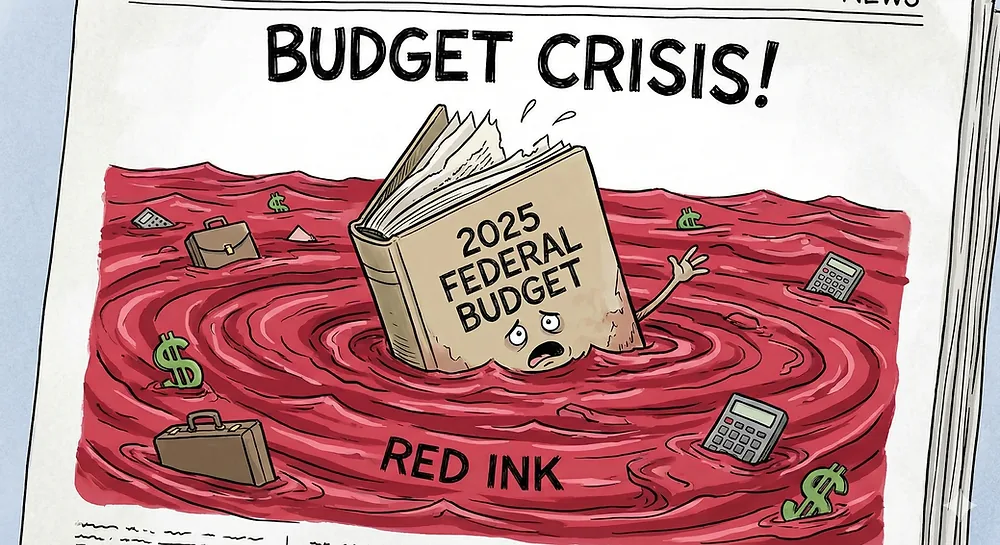
Canada’s 2025 federal budget is one of the most ambitious documents the government has released in the past decade. It promises to accelerate housing construction, stimulate productivity, build infrastructure, retrain workers, and reshape the economy. It also projects a $78-billion deficit while insisting Canada still holds the strongest fiscal position in the G7. But once you look past the headlines, a different story emerges: one where fiscal ambition and economic reality are pulling in opposite directions. This breakdown explains Budget 2025 in clear language, how much the government is actually borrowing, how the programs work, and how all of this will influence mortgage rates and affordability in the years ahead.
1. The $78B Deficit Isn’t the Real Number
The budget reports a $78-billion deficit, but that figure reflects only program spending shortfalls. It excludes several categories of required financing such as loans to Crown corporations, capital injections, CMHC expansion, and other non-budgetary needs. Once those are included, Ottawa’s true cash-borrowing requirement rises closer to $150 billion. Bond investors react to the real borrowing requirement, not the number printed in the budget book. More borrowing increases the supply of government debt, which pushes bond yields higher. When yields rise, mortgage rates follow. When the government says Canada has the “lowest net debt in the G7,” it is using a definition no other G7 country uses. Canada reports only the federal portion of net debt. Every other G7 country includes all levels of government in their calculation — national, regional, state, and local. If Canada used the same method as other countries and combined federal and provincial debt, we would no longer appear at the top of the G7. We would sit much closer to the middle of the pack. Bond investors know this, which is why market pricing reflects Canada’s true debt load, not the figure printed in the budget.
2. The Housing Plan: Ambitious Spending, Misaligned Incentives
Budget 2025 directs tens of billions toward modular housing factories, development on federal lands, faster permitting, and rental-focused construction. The scale is significant; the alignment is not. Most Canadian families want ground-oriented homes, townhouses, duplexes, and family-sized units. Yet federal spending still prioritizes high-density projects, micro-units, modular infill, and nonprofit-led rentals.
In plain language, we are not building homes you will be able to buy. We are building units that will mostly be rented to lower-income households. This may help with immediate shelter needs, but it does not expand the supply of family-oriented properties that allow Canadians to build equity and long-term stability.
Without municipal zoning reform, faster approval timelines, and a much larger skilled labour force, this money risks accelerating production of housing types that do not match real market demand. The issue isn’t the level of spending. It is the misalignment between federal priorities and what families actually need for long-term stability.
3. Immigration Changes: Directionally Right, Operationally Incomplete
The budget modestly reduces immigration targets and shifts intake toward workers rather than students. This moves in the right direction but remains a partial answer. Canada’s housing bottleneck is fundamentally a labour bottleneck. The country does not have enough electricians, carpenters, plumbers, HVAC technicians, heavy-equipment operators, or other skilled trades. Budget 2025 expands training seats and offers incentives, but it still does not deliver anything close to a national skills strategy or a fast-track system for apprenticeships and foreign credential recognition. The reduction in student intake will ease rental pressure in college and university areas. These markets could see some repricing, which may help families find appropriate housing and force some overleveraged investors to sell. But this also creates major revenue gaps for educational institutions, gaps that governments or remaining students will eventually need to fill.
4. The Benefits System: Generous at the Bottom, Harsh in the Middle
Canada’s benefit structure substantially reduces material poverty for families with children. When supports such as the CCB, GST credit, Canada Workers Benefit, provincial programs, and housing assistance are combined, a low-income family in BC earning $25,000 can end up with $50,000 to $60,000 in disposable income. But as incomes move into the middle range, the system becomes punitive. Between roughly $60,000 and $110,000, families lose the GST credit, provincial benefits, the Workers Benefit, housing supports, and a large portion of the CCB. Higher earnings often produce little net gain. Meanwhile, Old Age Security is based on individual income rather than household income and includes a very high threshold. A retiree begins to repay OAS only after $86,000 of income, and full clawback doesn’t occur until about $148,731. A family with combined income of $75,537 sees benefits fall sharply, while a retired couple earning close to $300,000 can still receive government support. Readers can decide for themselves whether that makes sense.
5. Administrative Overhead: A Costly System That Reinforces Dependency
Canada’s benefits system is layered, complex, and expensive to administer. It requires constant recalculations, ongoing CRA audits, overlapping provincial and federal rules, and dozens of clawback formulas. A simpler system, such as increasing the basic personal exemption and consolidating child benefits, could reduce administrative costs and eliminate many poverty traps. But politically, complexity is often rewarded. Monthly deposits feel more visible than tax reductions, and targeted benefits create the perception of direct support. Budget 2025 adds new layers instead of simplifying the architecture. It succeeds at preventing the bottom 20 percent from falling into extreme hardship, but it does far less to enable upward mobility. Real mobility comes from a growing economy with higher productivity, not from longer work hours. Better tools, better machinery, better software, and better infrastructure are what lift wages sustainably.
6. Cutting 40,000 Federal Employees: Necessary or Risky?
The government plans to reduce the federal workforce by 40,000 positions through attrition and retirements. The public service grew substantially from 2016 to 2023, and trimming its size is defensible. The challenge is timing. Cutting tens of thousands of stable incomes during a period of economic fragility risks reducing consumer spending, weakening small business revenues, and creating regional downturns in government-heavy cities such as Ottawa and Winnipeg. Ideally, government belt-tightening happens during strong economic years, not during average or weakening ones.
7. Borrowing and Interest Rates: The Coming Collision
Federal borrowing is rising to fund the deficit, finance Crown corporations, expand CMHC lending, and support new programs. Provinces and municipalities are also increasing their own borrowing for long-delayed infrastructure. This pushes total demand for capital sharply higher. The consequences are predictable: upward pressure on long-term bond yields, reduced liquidity for private borrowers, and less room for the Bank of Canada to cut rates. Fiscal policy is pushing rates upward while monetary policy is trying to bring inflation down. They are working against each other. Short-term rates may appear stable, but long-term mortgage rates will reflect the sustained borrowing environment. This is why Budget 2025 cannot be evaluated separately from the upcoming December 10 Bank of Canada announcement. Based on the latest data, no rate cut or increase is expected. We will analyze this in more detail in the December newsletter.
8. The Structural Issue Budget 2025 Leaves Untouched
Canada’s system is strong at preventing poverty but weak at enabling long-term stability. Low-income households receive robust support; high-income households experience minimal clawbacks; middle-income households face steep marginal tax rates, rapid benefit loss, high housing costs, and limited retraining opportunities. This creates a structure where remaining poor can feel safer than trying to climb, because the ladder is full of penalties. Budget 2025 expands existing programs but does not fix this underlying issue. In many ways, it reinforces it.
9. The Missing Piece: Open Banking and Financial Mobility
One of the most important tools for improving affordability and increasing competition in the financial sector is open banking. Budget 2025 mentions progress, but Canadians still cannot securely share their financial data between institutions the way consumers can in the UK, the EU, and Australia. Without open banking, switching lenders remains slow, paperwork-heavy, and expensive, which reduces competition and keeps borrowing costs higher than they need to be.
Open banking would allow families to move their accounts, verify income, and compare mortgage offers instantly. It would make renewals more competitive, reduce fees, and strengthen households’ bargaining power. For a government focused on affordability and financial inclusion, this should be a foundational priority, yet its implementation remains stalled. Like many parts of Budget 2025, the intention is there, but the execution is missing.
Conclusion: Ambition Without Alignment
Budget 2025 attempts to address real problems: housing shortages, stagnant productivity, infrastructure deficits, and inequality. But many of its tools contradict one another. It increases spending while trying to tame inflation. It expands borrowing while hoping for lower rates. It subsidizes modular housing instead of the family-oriented homes Canadians want. It adds complexity to a system that already overwhelms families. Canada does not need more programs. It needs better alignment between fiscal choices, labour realities, and the long-term needs of households. Until fiscal and monetary policy move in the same direction, and until the system rewards upward mobility instead of punishing it, affordability will remain out of reach for too many Canadians. That is the deeper story behind Budget 2025.
Simon Bilodeau and Gina Lopez
604-828-9864
Simon Bilodeau is a mortgage broker, financial writer, and co-founder of RefinanceBC. He specializes in translating economic trends into clear mortgage strategies for BC homeowners. Often featured on Radio-Canada and CBC, Simon is known for honest, data-driven advice delivered in plain language. He works alongside his wife Gina, forming a bilingual team serving clients across the province.