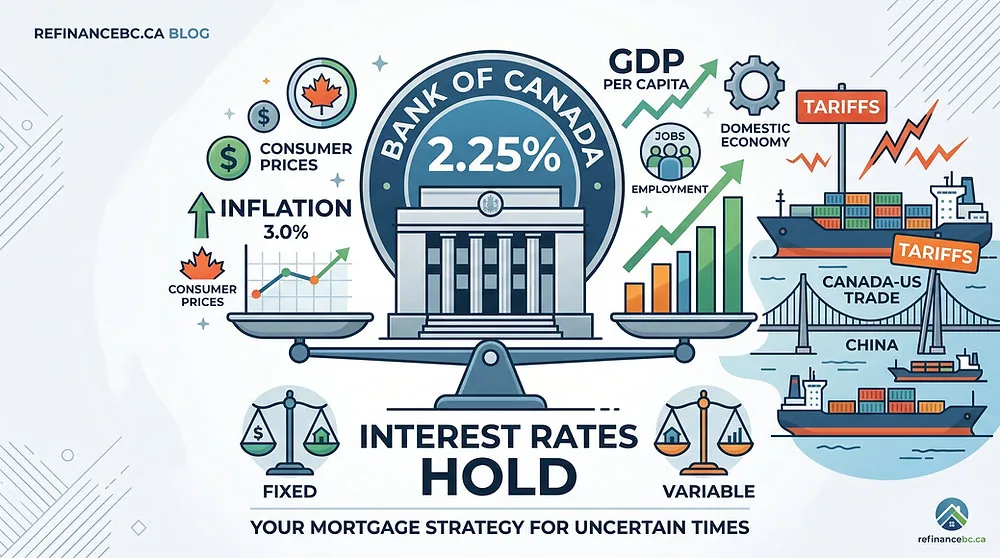
The Bank of Canada announced today that it is keeping its overnight rate unchanged at 2.25%.
This was widely expected, and frankly, there was very little reason for the Bank to do anything else.
The Canadian economy has performed somewhat better than expected over the last few months, but inflation remains elevated and the trade situation with the United States has deteriorated considerably.
For mortgage borrowers, my advice has not really changed.
Inflation Is Still the Problem
Canadian inflation reached 3.0% in July, putting it at the very top of the Bank of Canada's 1% to 3% target range.
This is probably the biggest reason why another rate cut is difficult to justify.
At the same time, the Canadian economy is certainly not overheating.
Unemployment remains relatively high, households are still adjusting to higher borrowing costs, and now we once again have significant uncertainty surrounding Canada's largest trading partner.
In other words, there isn't a particularly strong argument for cutting rates, but there isn't a particularly strong argument for increasing them either.
Holding at 2.25% makes sense.
The Economy Actually Had a Pretty Good Quarter
One of the more positive developments since my last update has been Canada's economic growth.
The Canadian economy grew much faster than expected during the second quarter.
Even more encouragingly, GDP per capita increased.
For the last few years, Canada's population has often been growing faster than its economy. That meant the economy could technically be growing while the amount of economic activity per Canadian was actually declining.
Seeing GDP per capita finally improve is therefore good news.
The employment picture has also improved somewhat, with Canada's unemployment rate declining to 6.4% in July.
None of this looks like an economy in crisis.
Unfortunately, just as the domestic numbers started looking somewhat better, the trade situation got considerably worse.
The Canada and U.S. Trade Deal Fell Apart
A few weeks ago, it looked increasingly likely that Canada and the United States were finally going to reach some kind of trade agreement.
That didn't happen.
Negotiations collapsed in August and the United States moved ahead with additional tariffs on Canadian products. Canada has responded with retaliatory tariffs of its own.
As of this week, the two countries aren't even actively negotiating.
Prime Minister Mark Carney said that Canada remains willing to return to the negotiating table, but that the United States first needs to become serious about reaching an agreement.
This is probably one of the biggest risks to the Canadian economy right now.
And the problem isn't simply the tariffs themselves.
It's the uncertainty.
Imagine that you operate a Canadian company and you're considering spending $50 million expanding a factory.
Do you make that investment if you don't know what tariff will apply to your products six months from now?
Do you hire another 100 employees?
Do you build the factory in Canada, or somewhere else?
Even companies that aren't currently affected by tariffs may postpone investment simply because they don't know what happens next.
And Now We Have China
This is where things could become even more complicated.
Canada has been trying to reduce its dependence on the United States by developing stronger trade relationships elsewhere, including with China.
Earlier this year, Canada and China reached a limited trade agreement that reduced some of the tariffs between the two countries.
President Trump responded on Truth Social by threatening 100% tariffs on Canadian goods if Canada entered into a broader trade agreement with China.
Canada is now in a difficult position.
Our largest trading relationship has become considerably less predictable, so logically Canada needs to diversify its trade.
But one of the largest alternative markets in the world is China, and developing a closer relationship with China could potentially trigger even more tariffs from the United States.
Whether those threats actually become policy is impossible to know.
But businesses have to make decisions today based partly on what could happen tomorrow.
And that uncertainty has a real economic cost.
Iran Is Still the Other Big Wildcard
The trade war isn't the only geopolitical problem complicating the Bank of Canada's job.
The conflict with Iran has escalated again.
The United States launched new strikes against Iran this week, Iran has responded, and the Strait of Hormuz, one of the world's most important routes for oil and natural gas, remains severely disrupted.
Oil prices immediately moved higher again, with Brent crude climbing back above US$90 per barrel.
Why does a conflict thousands of kilometres away matter to Canadian mortgage rates?
Inflation.
We have already seen the effect this year.
Higher oil prices have pushed gasoline prices higher, and those costs don't stop at the gas pump. Transportation becomes more expensive, airlines pay more for fuel, trucking becomes more expensive, and eventually some of those additional costs work their way through the prices of other goods and services.
The Bank of Canada has already acknowledged that the conflict in the Middle East has been a significant contributor to Canada's higher inflation this year.
And this creates another difficult situation for the Bank.
Normally, a slowing economy would make lower interest rates more likely.
But if the slowdown happens at the same time that an oil shock is pushing inflation higher, cutting rates becomes considerably more difficult.
So we now have two major external risks pulling on the Canadian economy.
The trade war with the United States threatens Canadian investment, exports, and employment.
The conflict with Iran threatens global energy supplies and pushes inflation higher.
Unfortunately, neither is something the Bank of Canada can control with interest rates.
So, Where Do Interest Rates Go From Here?
This is where I think things become interesting.
A few months ago, the discussion was still largely about when the Bank of Canada might cut rates again.
I think that conversation has mostly run its course.
At 2.25%, the Bank of Canada rate is already relatively low. Inflation is around 3%, the economy has performed better than expected, and there is no obvious reason for the Bank to stimulate the economy aggressively.
Without the trade situation, we might actually start discussing whether the next move could eventually be a rate increase.
But tariffs complicate everything.
Tariffs can increase prices, which creates inflation.
At the same time, a trade war can reduce investment, employment, and economic growth.
That leaves the Bank of Canada facing two opposing problems at exactly the same time.
Higher inflation argues for higher interest rates.
A weaker economy argues for lower interest rates.
For now, the most logical response is probably exactly what the Bank did today:
Nothing.
What Does This Mean for Your Mortgage?
Not very much has changed.
I still don't think anyone should choose a variable rate mortgage because they are expecting a series of large Bank of Canada rate cuts.
Could the Bank cut again if the economy deteriorates significantly? Absolutely.
But I wouldn't build a mortgage strategy around that prediction.
If you choose a variable mortgage today, you should be comfortable with the payment today and choose it because you value the flexibility and are comfortable accepting changes in interest rates.
The same principle applies to fixed mortgages.
Fixed mortgage rates are primarily influenced by the bond market, not directly by today's Bank of Canada announcement.
Trying to predict exactly where bond yields or the Bank of Canada rate will be one, two, or three years from now is extremely difficult.
Instead, the decision between fixed and variable, and between a three year or five year term, should depend on your financial situation, your tolerance for risk and, most importantly, what you expect to do with the property and mortgage during that period.
My Outlook
The Bank of Canada holding at 2.25% today was the outcome I expected.
The Canadian economy has actually shown some encouraging signs.
Inflation remains higher than we would like, but unemployment is still elevated and the economy isn't overheating.
The biggest wildcard is once again trade.
Negotiations between Canada and the United States have failed, tariffs have increased, and Canada's attempts to diversify trade toward countries such as China could potentially create another confrontation with the United States.
At the same time, the conflict with Iran and the disruption of global energy markets are adding another source of inflationary pressure.
That combination makes predicting the economy six or twelve months from now unusually difficult.
For mortgage borrowers, however, the advice hasn't changed.
Don't choose your mortgage based on trying to predict the next Bank of Canada announcement.
Choose the mortgage that works for your finances and your plans today.
And if the world changes again?
We adjust.
Simon Bilodeau and Gina Lopez
604-828-9864
Simon Bilodeau is a mortgage broker, financial writer, and co-founder of RefinanceBC. He specializes in translating economic trends into clear mortgage strategies for BC homeowners. Often featured on Radio-Canada and CBC, Simon is known for honest, data-driven advice delivered in plain language. He works alongside his wife Gina, forming a bilingual team serving clients across the province.